Capitals of Punk by Tyler Sonnichsen
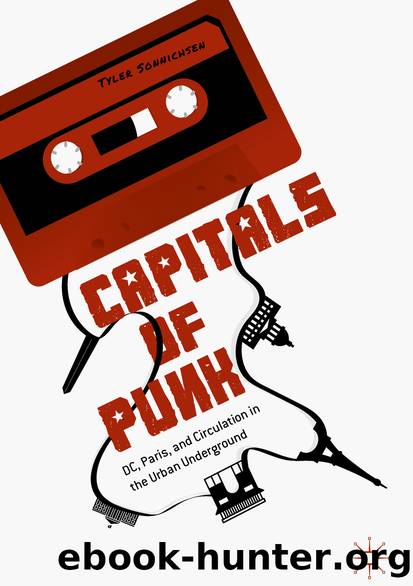
Author:Tyler Sonnichsen
Language: eng
Format: epub
ISBN: 9789811359682
Publisher: Springer Singapore
Farid is one of few remaining signposts of the Oberkampf neighborhoodâs sordid past. One hundred years ago, Menilmontant and Belleville fostered elements of the cityâs premodern era, still full of cottages and rustic gardens. By the 1980s, the aesthetic had shifted to something much less bucolic. The vacant, blighted storefronts that once filled the street have given way to a French hybrid of gentrification and âembourgeoisementâ over the past 20 years. The term âgentrificationâ became prominent in French urban reportage in the late 1980s, though the process had been active for over 20 years by that point. Belleville, which lies directly north of Menilmontant and runs over to Rue Pixérécourt on its eastern edge, resisted most city-coerced redevelopment until recently. Where the Belleville neighborhood was, as of a decade ago, âmade of social housing and rundown buildings, where working class immigrants from Northern Africa and China livedâ (Clerval 2008), the dominoes of development have fallen on this area recently. Granted, the city has had designs on it for years. According to geographer Neil Smith (1996), Belleville in the mid-1990s was a âsolidly working-class neighborhood in the northeastern outskirts of Parisâ¦a major center of Arab, African, Chinese and East European immigration and a traditional stronghold of proletarian oppositionâ (p. 180). The city already had âamelioration schemesâ and designs on the neighborhood at work by that point. In more recent years, establishments like the Belleville Brûlerie (cofounded by DC expat David Flynn) on Rue Pradier and Café Charbon on Rue Oberkampf have been de facto flagships of the neighborhoodâs transformation into an upper-middle-class hovel. Thirty years ago, it would have been unrecognizable.
Philippe Roizès told me as much as we walked down Rue Oberkampf, toward the Menilmontant Metro station in the 11th Arondissement. Thirty years ago, suburban punks like Roizès were unable to get from the Metro station two blocks away to hardcore matinees at Le Cithéa without being confronted by roving skinheads. Roizès recalls confrontations of his own as well as altercations he witnessed or heard of second-hand that turned violent or fatal. Although he knew the earliest skinheads in Colombes, Phillippe was too young to fall in with their crew. As skinheads became more rampant and violent in Paris in the early 1980s, their presence irrevocably influenced how punks navigated the urban landscape. On a smaller scale, Roizès and his school friends would steer clear of New Rose whenever there were skinheads hanging out in front of the boutique. They would duck away and return later, hoping the thugs had gotten bored and moved along. As the 1980s progressed, right-wing street gangs grew and this tense dynamic expanded citywide. Young punks, especially those known to affiliate with anti-Fascist gangs like the Red Warriors and Ducky Boys, needed to strategically plan their Metro trips throughout the city. Les Halles, Luxembourg, and the Clignancourt Flea Market were among the most dangerous stations to cross at the wrong times (Vecchione 2008).
The rampant street violence, compounded with the unfavorable timing of the shows, made the fledgling hardcore scene increasingly fragile.
Download
This site does not store any files on its server. We only index and link to content provided by other sites. Please contact the content providers to delete copyright contents if any and email us, we'll remove relevant links or contents immediately.
The Goal (Off-Campus #4) by Elle Kennedy(13674)
Kathy Andrews Collection by Kathy Andrews(11834)
Diary of a Player by Brad Paisley(7581)
Assassin’s Fate by Robin Hobb(6218)
What Does This Button Do? by Bruce Dickinson(6207)
Big Little Lies by Liane Moriarty(5804)
Altered Sensations by David Pantalony(5105)
Pale Blue Dot by Carl Sagan(5008)
Sticky Fingers by Joe Hagan(4199)
The Death of the Heart by Elizabeth Bowen(3622)
The Heroin Diaries by Nikki Sixx(3550)
Confessions of a Video Vixen by Karrine Steffans(3309)
Beneath These Shadows by Meghan March(3308)
How Music Works by David Byrne(3270)
The Help by Kathryn Stockett(3147)
Jam by Jam (epub)(3093)
Harry Potter 4 - Harry Potter and The Goblet of Fire by J.K.Rowling(3074)
Computational Linguistics and Intelligent Text Processing: 20th International Conference, CICLing 2019 La Rochelle, France, April 7â13, 2019 Revised Selected Papers, Part I by Alexander Gelbukh(2995)
Strange Fascination: David Bowie: The Definitive Story by David Buckley(2872)
